Structurals
Chapter 18
Plinth Violations: How pipes Destroy RCC Foundations
How casual penetrations, poor coordination, and site-level shortcuts at plinth stage silently compromise RCC foundations, floor systems, and long-term durability.
~14 min read
Last updated: Apr 12, 2026
Plinth Violations#
The plinth beam is one of the most abused structural elements in residential construction—especially in Kerala.
It quietly replaced rubble masonry foundations, but it was never intended to become a utility corridor.
Yet on most sites, that is exactly what it becomes: cut, drilled, penetrated, loaded, and ignored.
A plinth beam must be treated with the same respect as any structural beam.
Once violated, the damage is permanent—even if it remains invisible for years.
The False Assumption Behind Most Plinth Damage#
Most structural designs quietly assume that a plinth beam:
- rests on firm, uniformly compacted soil
- behaves as a partially supported member
- remains structurally intact after casting
That assumption fails the moment:
- pipes are routed through the beam
- large conduits are passed through core-cut drilling later
- heavy equipment moves across it for consolidating soil fill
- the fill beneath is loose or uneven hence no firm support as assumed
From that point on, the plinth beam no longer behaves like a beam.
It becomes a fractured transition element, forced to absorb and conceal every downstream mistake.
Minimum Geometry and Material — Not Optional#
For residential construction under Kerala conditions, the following are practical minimums, not premium choices:
Plinth beam depth
- Absolute minimum: 450 mm
- Preferred for service pipes: 600 mm
Concrete grade
- Minimum: M30
- Prefer M35 in aggressive or laterite-rich soil
Concrete cover
- 50 mm, without compromise
⚠️ Site Rule
If a plinth beam is expected to survive real-world penetrations, moisture exposure, and soil contact, it must be sized and graded for reality—not drawings.
Laterite Fill: The Hidden Risk Inside the Plinth#
In most Kerala houses, the area inside the plinth is:
- filled with soil
- topped with PCC
- finished as a ground-floor slab
The problem is not PCC.
The problem is the fill material beneath it.
Laterite soil—locally available and often assumed to be “good”—is:
- moisture-retentive
- chemically aggressive
- highly variable in compaction behavior
Even when native soil is not laterite, imported fill is frequently laterite.
This is why:
- M30 is the minimum
- durability decisions matter below finished floors
Plumbing Violence: Where Plinth Beams Suffer Most#
Plumbing and core cutting for pipes is the single biggest reason plinth beams get destroyed.
If pipe routes are not finalized before plinth casting:
- workers will cut holes later
- “temporary” openings become permanent damage
- structural intent is lost
A dangerous myth promoted by some social-media “experts” is that pipes can safely pass through plinth beams if placed before concreting.
In reality, even pre-planned penetrations are highly destructive when the pipe diameter is compared to the available beam’s cross-section.
❌ Common Mistake
Allowing “planned” penetrations through plinth beams—before or after casting.
There is no such thing as a harmless hole in a beam.
Why a 600 mm Plinth Allows Safer Service Penetrations#
A 600 mm plinth beam does not eliminate risk, but it improves structural tolerance when limited service penetrations are unavoidable and explicitly approved by a structural engineer.
The governing factor is effective depth.
When a pipe passes through a plinth beam, the beam’s capacity is controlled not by its total depth, but by the remaining effective depth after the opening. In shallow plinth beams (300–450 mm), even small penetrations can intrude into critical zones, sharply reducing shear and flexural capacity.
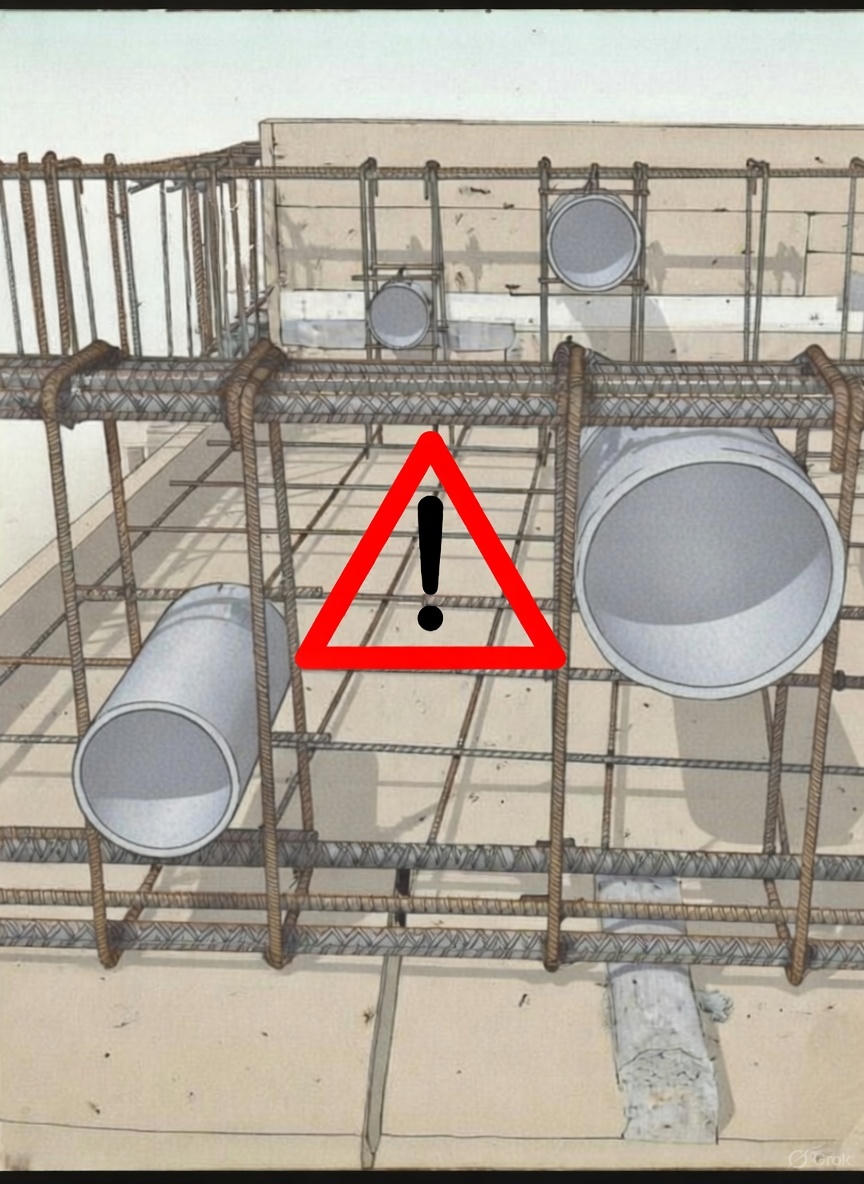
Sewage pipes should never be allowed through any beam. Large-diameter waste lines destroy effective depth, interrupt reinforcement continuity, and create permanent structural damage that cannot be corrected later.
With a 600 mm plinth:
- limited penetrations can be positioned away from compression and main tension zones
- sufficient residual effective depth remains for structural verification
- penetrations can be calculated, detailed, and justified, not improvised on site
This does not make penetrations safe by default.
It makes them structurally verifiable.
A deeper plinth increases the likelihood that unavoidable service crossings do not compromise long-term safety, because decisions are driven by engineering calculations, not site convenience.
For a plinth beam of 230 mm width × 600 mm depth, any pipe penetration must be treated as an exception, not standard practice. Even under the most favorable conditions—single opening, near midspan, away from beam–column joints—the practical upper limit for a circular opening is ≈100 mm diameter. Larger openings (such as those required for 110 mm soil pipes with sleeves of 125–140 mm) materially reduce effective depth and must not be permitted without explicit structural re-design. This assumption holds only if:
- a single penetration exists in the beam segment
- the opening is kept clear of high-shear zones (≈2× beam depth from supports)
- no main reinforcement is cut or displaced
- the penetration is fully reviewed and approved by the structural engineer
A 600 mm plinth improves tolerance—it does not make penetrations inherently safe.
Toilet Routing Strategy: Why a 20 cm Drop Matters#
A vertical drop of about 20 cm from plinth top in toilet areas may look minor on drawings,
but it has major practical advantages in real construction.
What usually goes wrong without the drop#
In conventional layouts, toilet waste pipes are routed:
- through soil directly below the toilet floor or cut through plinth beam
- embedded in fill that cannot be inspected
- surrounded by laterite and organic material
This zone becomes a preferred pathway for termites and is inaccessible once flooring is complete.
What the 20 cm Drop Enables#
A controlled 20 cm floor drop, when planned early, allows:
- routing toilet waste pipes above plinth level if we place commodes close to exterior walls
- wall-side routing instead of soil-embedded routing
- pipe penetrations above ground contact
- easier inspection during construction
- cleaner slab–plinth detailing
This removes the need to bury pipes directly under the toilet floor.
Termite Control Advantage (Often Overlooked)#
When pipes pass through soil:
- termite treatment becomes localized and uncertain
- re-treatment requires guesswork
- voids form around pipes over time
Routing pipes above soil level:
- keeps penetrations out of termite-active zones
- allows repeatable and targeted treatment
- avoids disturbing chemical barriers later
This is a long-term maintenance advantage, not just a construction detail.
Why Wall-Mounted Toilets Make This Easier#
Wall-mounted WCs help because:
- discharge is horizontal, not downward into soil
- outlet invert is higher than floor-mounted toilets
- deep floor penetrations are avoided
Combined with:
- a 20 cm toilet floor drop
- short horizontal runs
- controlled slopes
toilet waste lines can be routed cleanly above the plinth, without cutting beams or burying pipes.
Practical Limitation (Important)#
A 20 cm drop works only with planning:
- only for a wall-mounted commodes with known outlet height close to exterior walls
- short pipe runs providing necessary slope- can not have long track on floors
- no on-site improvisation
A 20 cm drop is generally not sufficient for floor-mounted (S-trap) toilets hence do not provide a significant advantage.
Electrical Pipe Routing: A Structural Issue#
Because KSEB does not allow direct underground entry into meters:
- meters are best placed near the street
- private underground feeders must be routed inside the plot
⚠️ Site Rules
- provide separate 75 mm (3-inch) PVC conduits(Suficient for most houses within 3000 sq feet area,use 4 inch or higher if unsure)
- use long-radius sweep bends, never sharp 90°
- slope conduits 1% away from the building
- provide inspection chambers
- seal entries with non-hardening duct seal to prevent insect and ants from damaging insulation
❌ Common Mistake
Core-cutting plinth beams for electrical conduits.
This is structural damage disguised as convenience.
Termite Treatment: No Permanent Fix Exists#
Termite protection is often ignored because it offers no visible return—until it fails.
Facts that matter:
- no termite treatment is permanent
- all chemical barriers degrade over time
- Kerala has high termite pressure from warm and wet soils
- warm, moist soil accelerates chemical breakdown and activity cycles
Chemical treatment is not protection forever.
It is time bought, nothing more.
A note on fipronil-based treatments#
Fipronil-based termiticides are widely used because they are:
- highly effective at very low concentrations
- slow-acting (allowing colony transfer)
- persistent in soil
That persistence is also the concern.
Fipronil is classified as a possible human carcinogen in some regulatory frameworks, and its long soil life means:
- it remains active for years
- it is harder to fully isolate from occupied structures
- application quality and containment matter greatly
For these reasons, some homeowners consciously choose not to use fipronil inside or immediately around living spaces, despite its effectiveness.
Imidacloprid (Premise SC): A more conservative alternative#
Imidacloprid-based products (such as Premise SC 30%) are commonly used as an alternative.
Key characteristics:
- contact and ingestion toxicity to termites
- lower soil persistence compared to fipronil
- generally considered less hazardous to occupants when properly applied
- significantly more economical per square foot
In dark, undisturbed environments—such as beneath PCC slabs and inside plinth zones—imidacloprid can remain effective for several years.
Field experience and manufacturer data typically indicate 3–6 years of useful protection under such conditions, depending on:
- soil type
- moisture exposure
- application quality
- disturbance over time
This is not lifetime protection, but it is predictable, repeatable, and easier to reapply.
The real trade-off (often ignored)#
The choice is not:
“best chemical vs weaker chemical”
It is:
- long persistence vs lower residual risk
- maximum longevity vs easier retreatment
- high potency vs conservative exposure
In residential construction—especially when application quality depends on unskilled or semi-skilled labor—a product that is:
- easier to apply correctly
- less sensitive to minor dosing errors
- safer around occupied spaces
can be the more responsible choice.
The principle that matters more than the product#
Termite control is a maintenance strategy, not a one-time decision.
No chemical removes the need for:
- proper detailing
- avoiding soil–pipe contact
- accessible treatment zones
- repeat applications over the building’s life
Choosing a treatment is choosing how you want to manage risk over time, not how to eliminate it.
Ground-Floor Slabs on Fill: Compact or Pay Later#
Filling the plinth requires planning, coordination, and labor—
which is exactly why contractors try to rush it.
Casting a ground-floor slab over filled soil without proper compaction guarantees problems.
Not may.
Will.
When fill is poorly prepared:
- soil continues to settle
- slabs sink unevenly
- surface undulations develop
- tiles and finishes crack months or years later
This is not bad luck.
It is basic soil behavior.
Why Water and JCB Mixing Is Not Compaction#
Flooding laterite soil and churning it with a JCB is often presented as compaction.
It is not.
Water + JCB only mixes soil.
It does not increase density or eliminate voids.
A Simple Way to Understand This#
Think of laterite fill like wet rice in a bowl.
Stir it into a mush—it looks level.
Leave it untouched—it settles.
Leave it longer—it settles more.
At no point does it compact itself.
Mechanical compaction is pressing it down firmly, layer by layer.
Time causes consolidation.
Compaction creates density.
Laterite behaves the same way.
What Proper Preparation Actually Means#
- fill placed in 200–300 mm (8–12 inch) layers
- each layer mechanically compacted
- moisture adjusted only to optimum levels
- no flooding, no slurry, no shortcuts
Skipping this step does not collapse the building.
It permanently damages the floor system.
Heavy Machinery: A Non-Negotiable Warning#
Never allow heavy machinery to run over plinth beams.
This includes:
- JCBs
- skid-steers / Tomcats
- excavators
- loaded trucks
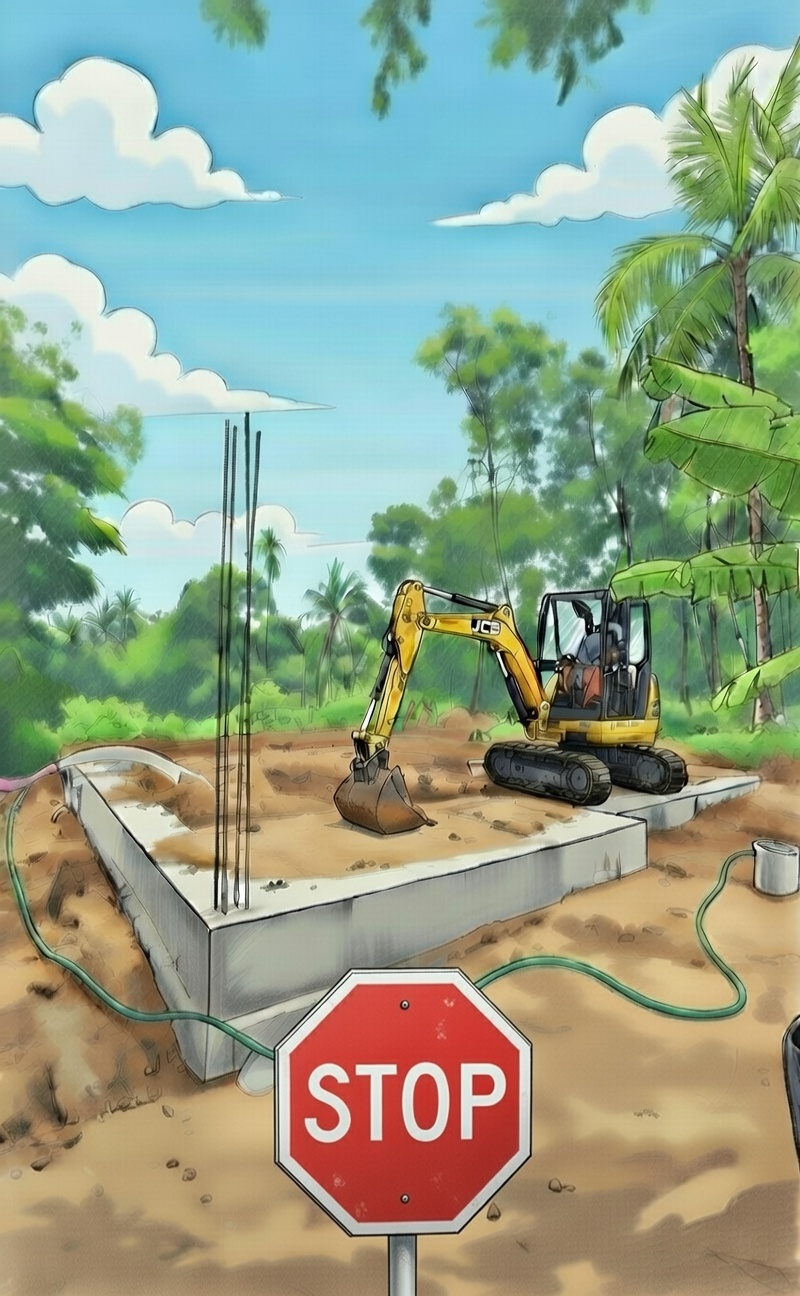
Heavy machinery is never allowed on a plinth beam for any reason. Plinth beams are not designed for concentrated construction loads, and placing equipment on them can cause cracking, overstress, and long-term structural damage.
Even M30 concrete is not immune to impact or vibration.
Damage here:
- creates microcracks
- remains invisible
- cannot be repaired later
Once compromised, the weakness remains for the life of the structure.
The Real Lesson#
Plinth violations are not dramatic.
They are quiet, cumulative, and permanent.
They happen because:
- planning was deferred
- coordination was avoided
- “we’ll manage later” was accepted
Anything you violate below plinth level will come back years later—
when fixing it is no longer possible.