Basics
Chapter 12
In Concrete We Trust
Why the real lifespan of a house in Kerala is determined less by drawings and more by concrete quality, curing discipline, and on-site honesty.
~9 min read
Last updated: May 14, 2026
You are building a house… not a bridge.1
Concrete — The Silent Decider of Your Building’s Life#
This chapter is about one of the most crucial, least understood elements of your construction: the concrete.
We’ve all seen it, touched it, stood on it — but very few understand how it works, and fewer still understand why concrete quality determines whether your home lasts 15 years or 75 years.
Modern concrete is made of:
- cement
- sand
- coarse aggregates (crushed stone)
- water
- (and now, chemical additives)
Everyone knows this much.
But as usual, what matters is the part nobody explains.
What Does “M20” or “M30” Actually Mean?#
Concrete grade refers to the compressive strength of a standard cube after 28 days of curing.
The letter M stands for mix, and the number is the strength in N/mm².
Strength mainly comes from:
- cement content
- proper grading of
- controlled water–cement ratio
However, there is a practical limit:
On Indian residential sites, the realistic upper limit of hand-mixed concrete is M20.#
Even M25 requires a miracle combination of:
- strict mixing discipline
- controlled water
- trained labor
- chemical admixtures
Which is why:
Anything above M20 should ideally come from a ReadyMix Plant (RMC) plant.
Why Strength Isn’t Your Main Problem — Durability Is#
That structural engineer was correct:
even M20 is sufficient for strength for a typical two-story home.
But strength is not what fails first.
Water reaching rebars is what kills buildings.#
Concrete has a second, far more critical role:
To protect TMT steel from corrosion for decades.
The moment water reaches the steel — whether through cracks, honeycombing, weak concrete, insufficient cover, or poor curing — the countdown begins.
Steel rusts.
Rust expands.
Concrete cracks.
And the structure quietly starts dying from the inside.
Kerala’s Climate: Severe to Very Severe Exposure Zone#
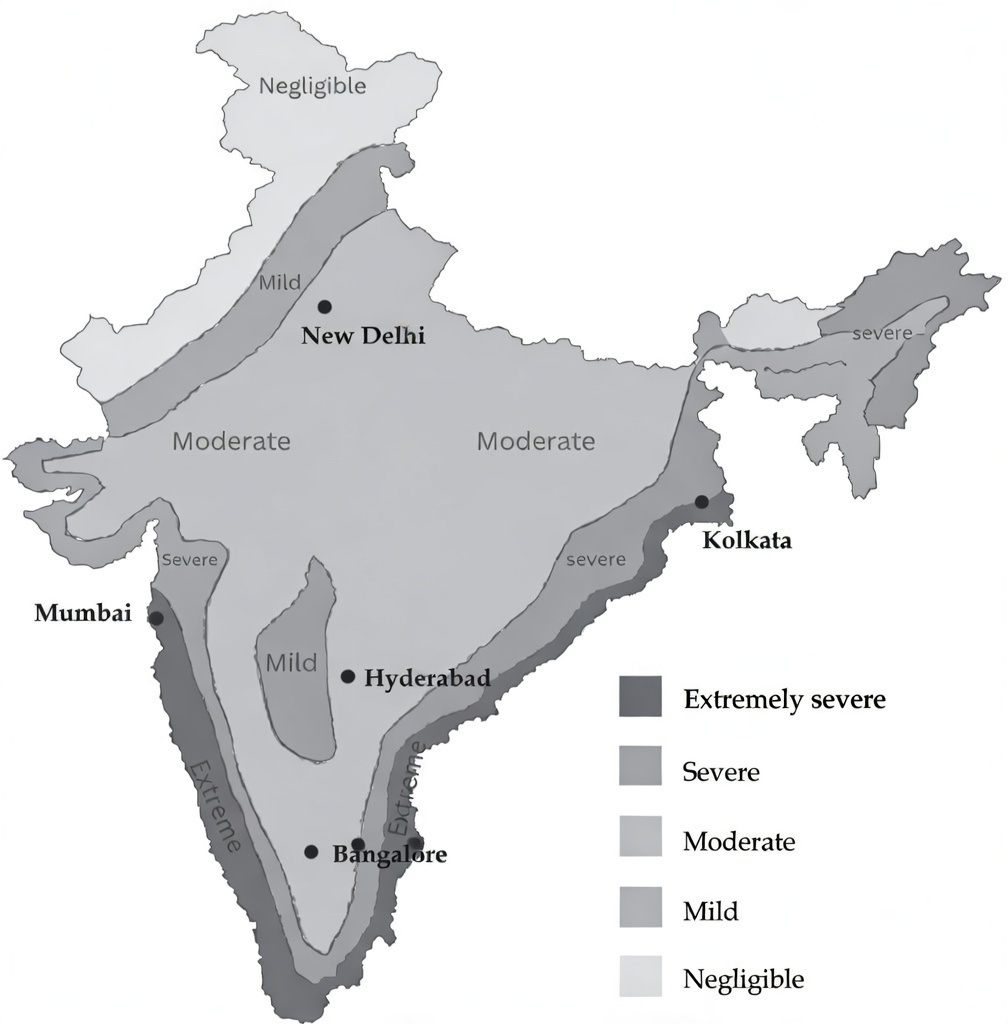
Kerala falls under Severe to Extremely Severe exposure zones.
Based on atmospheric corrosion maps (Corrosion Doctors), Kerala falls under:
Severe / Very Severe exposure category even when the building is not close to the sea.#
IS 456:2000 specifies minimum concrete grades based on exposure class:
| Exposure Class | Min Grade |
|---|---|
| Moderate | M20 |
| Severe | M30 |
| Very Severe | M35 |
| Extreme | M40 |
This means:
- Non exposed exterior beams/columns: M30
- Slabs, columns and beams exposed to rain cycles: M35
- foundations in wet soil: M30–M35
Yet, most homes are built with M15 or M20, mixed by hand, without using proper cover blocks.
Engineering Requirement: Proper Concrete Cover#
Concrete cover is the first and most important line of defense against corrosion in Kerala’s severe exposure conditions.
Here is a clear table of typical nominal cover requirements based on IS 456:2000.
| Structural Element | Nominal Cover (mm) | Exposure Notes |
|---|---|---|
| Slabs | 20–25 mm | Minimum allowed for mild/ moderate exposure. Avoid going below 20 mm under any condition. |
| Beams | 25–40 mm | 40 mm recommended for Kerala due to severe chloride exposure. |
| Columns | 40 mm | IS 456 requirement for severe + very severe conditions. |
| Footings | 50–75 mm | Higher cover required because footing concrete is permanently in contact with soil moisture. |
Table: IS 456:2000 nominal cover requirements adjusted for Kerala’s severe exposure category.
Rule of thumb (engineering approximation):
every additional 1 cm of cover can add ~10 years of corrosion resistance
(varies with climate, workmanship, and grade)
Typical Kerala sites provide bare minimum cover or even less.
That alone shortens a building’s life drastically.
Why Adding More Cement Does Not Give You M30 like concrete#
A common belief in site-mixed concrete is simple and wrong:
“Add one more bag of cement and it becomes M30 equivalent.”
It does not work that way.
Concrete grade is not decided by cement quantity alone. High-grade concrete depends on control, not excess. In practice, this means:
- a low water–cement ratio (≈0.40 or lower)
- correct aggregate proportion and grading
- the use of plasticizers or superplasticizers
- proper, preferably machine-controlled mixing
When cement is added to a site mix without reducing water, permeability increases and durability collapses. When water is reduced without admixtures, the mix becomes unworkable and compaction suffers. Either way, strength and durability are compromised.
This is why nominal mixes used at site hit a practical ceiling around M20, regardless of how much cement is thrown in.
Durability of concrete depends on both minimum cementitious content and the achieved concrete grade(IS456:2000). While nominal mixes often use more cement, they lack the water control and consistency needed to reach higher grades. The result is concrete that costs more but performs worse.
A properly designed ready-mix concrete (RMC) achieves higher grades not by wasting cement, but by controlling water, aggregate grading, and compaction. That control produces denser, less permeable concrete, which is what actually delivers long-term durability.
In simple terms:
Concrete mixed at site cannot match the longevity of a properly designed ready-mix, no matter how much extra cement is added.
Why Contractors Resist ReadyMix Concrete (and Why You Should Insist on It)#
RMC eliminates their favorite profit-making trick:
❌ Reducing cement bags quietly#
❌ Adding too much water to “make mixing easier.”#
❌ Poor sand, recycled aggregates#
❌ Reluctant to use proper cover blocks#
❌ No measurement of ingredients to keep ratios especially water.#
On pour day, during the chaos, nobody can count bags accurately. Workers often pour extra water to concrete because it feels more workable, not realizing it significantly weakens the final concrete. This is where the scam happens.
Callout: Common Contractor Scams in Concrete#
🚨 Common Contractor Scams in Kerala Concrete Work#
- Using 5 bags instead of 6.5 in M15
- Using 6 or 7 bags instead of 8 in M20
- Adding excessive water to improve workability
- Replacing fine aggregates(Sand) with poorly graded crusher dust mixed M sand
- Not using cover blocks so rebars touch shuttering
- Claiming “1:2:4 is M20” (it is M15, not M20)
- Using old cement(3 months or above from manufacture) bags with moisture lumps
Result:
Weak, porous concrete that starts cracking within a decade.
Nominal Mixes: The Contractor’s Favorite Confusion Tool#
Correct table below:
| Grade | Nominal Mix | Approx. Cement (bags/m³) |
|---|---|---|
| M10 | 1:3:6 | ~5 bags |
| M15 | 1:2:4 | ~6.5 bags |
| M20 | 1:1.5:3 | ~8 bags |
| M25 | 1:1:2 (not recommended in IS) | ~11 bags |
Important:
IS 456 prohibits using nominal mixes for M25 and above.
M25 nominal mix is extremely cement-heavy. At 1:1:2, the approximate cement requirement is about 11.1 bags per m³. This can be achieved by lowering water content using a superplasticizer, but leave that for an RMC or expert engineer to be safe. For practical site estimates, use the Concrete Mix Calculator, but treat M25 as a caution grade that should preferably be handled through engineer-approved design mix or RMC.
RMC vs On-Site Mixing (Side-by-Side Comparison)#
| Factor | Ready-Mix Concrete (RMC) | On-Site Mixing |
|---|---|---|
| Strength Consistency | Very high | Highly variable |
| Water–Cement Ratio | Controlled (≤0.45) | Usually excessive |
| Cement Theft | Impossible | Very common |
| Aggregate Grading | Lab-controlled | Random truck supply |
| Admixtures | Included | Rarely used correctly |
| Speed of Pouring | Fast, uniform | Slow, labor dependent |
| Probability of Honeycombing | Low | High |
| Durability | High (ideal for Kerala climate) | Low |
| Cost | Slightly higher or equal | Appears cheaper but costs more long-term |
| Testing | Cube report provided | No testing |
Why ReadyMix Concrete (RMC) Is Stronger — and Greener
RMC from reputed suppliers such as Ultratech delivers far superior and more consistent concrete — often at the same or even lower true cost once you account for cement theft, over-watering, and the inconsistencies of site-mixing.
Because RMC tightly controls the water–cement ratio, it can achieve higher grade concrete with less cementitious material. Where you might need 8 bags on site, an engineered RMC mix can reach the same (or better) performance using optimized aggregates and admixtures.
This approach is also environmentally responsible. An M25 design mix can be achieved with as little as 210 kg of OPC cement, with the remaining 25–35% of the cementitious content coming from industrial by-products such as fly ash or GGBS.
In short: with RMC, you get stronger, more durable concrete — and you are actually building a greener building.
Why Kerala Houses Fail Early#
Put together:
- very severe climate
- low durability concrete
- insufficient cover
- nominal mixes
- cement theft
- poor curing
- Unskilled supervision
- and water added freely…
…and you get:
Leaky slabs, rusted rebars, falling plaster, and visible cracks — all before the house turns 15.
It is not bad luck.
It is bad concrete.
The Only Sensible Approach Today#
1. Use Readymix from reputed vendors for all structural pours#
M30 for exterior elements. M35 for anything that gets wet repeatedly. But don’t blindly trust the “grade” label — even with RMC, demand 360–400 kg/m³ of cementitious material. Details regarding cement types in chapter 14: Cement Brand Mania. Durability comes from cement(itious) content; strength is just a bonus.
If Ready mix concrete is not available, your contract must state that every structural element — beams, columns, lintels, and slabs — shall use concrete with not less than 350 kg of cement per cubic meter. No exceptions, no negotiations.
2. Follow IS 456 cover thickness strictly#
- slab: 20–25 mm
- beams: 35–40 mm
- columns: 40 mm+
3. Avoid all nominal mixes above M20 if possible only use Ready Mix concrete from reputed vendors like Ultratech#
4. Document every pour (photos, videos, timestamps)#
5. Ask RMC plant for cube test reports and batch report with each delivery(No exception)#
This is how houses survive Kerala’s climate for decades — not years.
Footnotes#
This was the sarcastic reply from a well-known structural engineer when I asked about using M30 readymix for construction. He was right that a two-storey house doesn’t need M30 strength — but he completely missed why I asked. With an exposed box elevation in Kerala’s harsh climate, higher-grade concrete is about durability, not strength. ↩