Structurals
Chapter 17
No Fooling Around with Footings
Why soil testing, footing design, execution discipline, curing, and waterproofing decisions together determine the true lifespan of a residential building.
~12 min read
Last updated: Apr 12, 2026
No Fooling Around with Footings#
In a framed structure (column–beam system), footings transfer the entire building load into the earth. They are among the most critical structural elements in a residential building—and also among the most misunderstood.
Footing depth and size are not arbitrary decisions. They are determined by:
- soil bearing capacity
- column loads from the complete building
- permissible settlement
- structural calculations
Yet on many residential sites, footings are treated as a one-time concrete pour rather than the foundation of the entire load path. This mistake carries consequences that surface years later—when repairs are no longer possible.
The “Footing-Only Design” Trap#
One of the most common failures begins with how structural engineering is approached.
A surprisingly large number of structural engineers—especially in residential work—provide only footing drawings, without visualizing the entire structure above.
Most novices (including me) fall into this trap because:
- the structural engineer is engaged late
- construction pressure is already high
- having something on paper feels better than waiting
If this sounds familiar, read
Chapter 09: The Unsung Heroes.
❌ Common Mistake
Designing footings in isolation and “adjusting” reinforcement later on site.
This almost always leads to congested cages, compromised cover, or bars placed outside the column core.
A footing cannot be designed in isolation.
It must be part of a continuous system, visualized from footing to roof before construction begins.
Soil Testing Is Not Optional#
Before selecting a footing foundation, soil testing is mandatory.
For typical residential buildings:
- founding depth often falls in the 1.2–1.8 m range, but varies widely
- laterite, clay, filled soil, and mixed strata behave very differently
⚠️ Site Rule
No footing design should be finalized without soil investigation.
If soil conditions are unfavorable, isolated footings may not be appropriate at all.
PCC Below Footing: Not “Just for Leveling”#
Before casting RCC footings, a Plain Cement Concrete (PCC) base must be provided.
This PCC:
- creates a clean working surface
- ensures correct rebar cover
- prevents direct RCC–soil contact
- improves durability and quality control
❌ Common Mistake
Treating PCC as cosmetic or skipping curing because “it’s only a base layer”.
⚠️ Site Rule
- Minimum PCC grade: M20
- Minimum curing before RCC footing: 7 days
Footing Concrete: Design for Durability, Not Just Strength#
Footings remain permanently buried, often exposed to:
- moisture
- aggressive soils
- organic and chemical pollutants
For this reason:
- minimum M30 grade concrete is strongly recommended
- blended cement ( or fly ash) improves long-term durability
(Refer Chapter 12: In Concrete We Trust.)
Waterproofing in Laterite Soil: Where It Makes Sense#
In laterite soil, long-term soil–concrete–steel interaction can accelerate deterioration if durability is not addressed at the foundation stage.
Laterite is not chemically neutral.
It is iron-rich, moisture-retentive, and oxygen-permeable—a combination that is hostile to reinforced concrete over time.
In Kerala, laterite soil is predominant across most districts. Even where native soil differs, a large share of land-filling material is sourced from laterite-rich regions of the Western Ghats and its extensions.
As a result, many residential foundations ultimately sit in lateritic or laterite-contaminated fill, regardless of original site conditions.
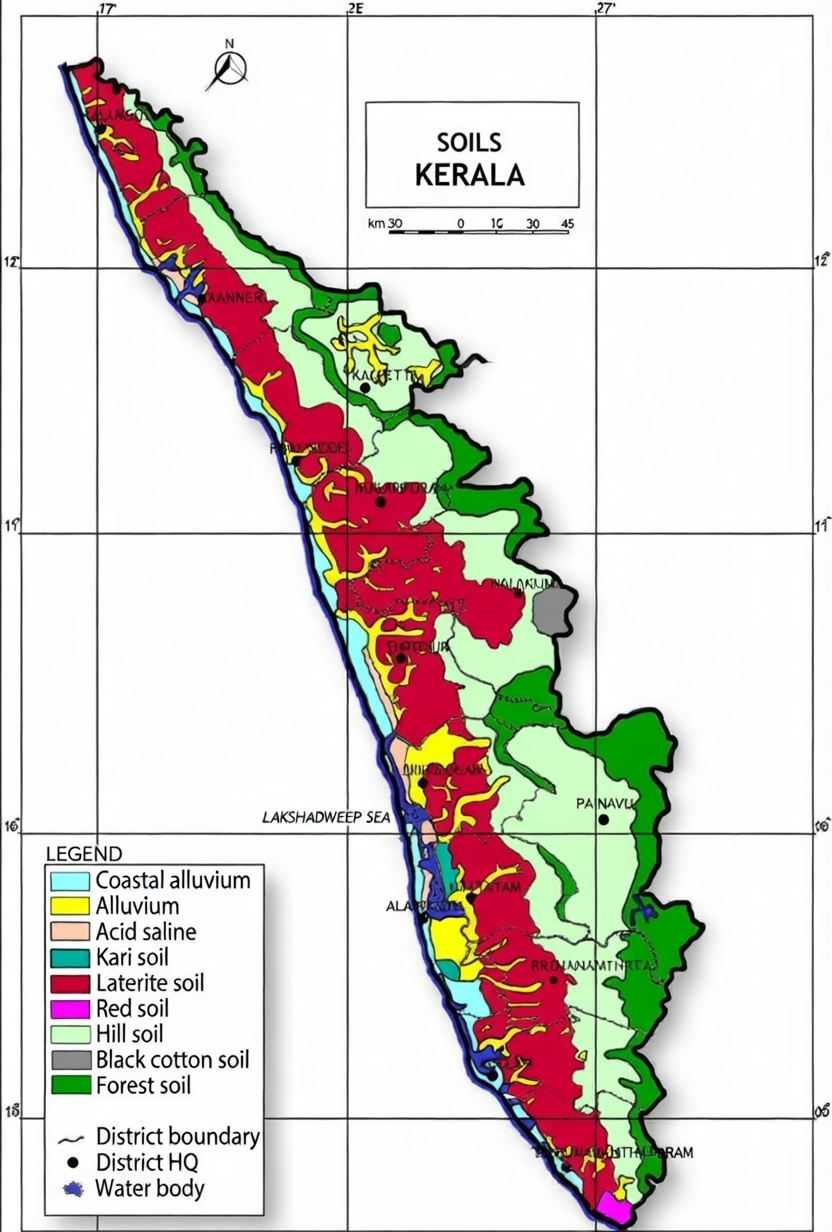
Distribution of laterite soil in Kerala. Lateritic formations dominate large parts of the state and are also the primary source of land-filling material from the Western Ghats, making laterite exposure common in residential foundations.
For reinforced concrete, the risk is cumulative:
- persistent moisture keeps concrete surfaces damp
- iron-rich soil promotes electrochemical activity
- oxygen availability accelerates loss of rebar passivation
This is why corrosion often begins at footing edges and plinth zones, not in upper structural members.
Using pre-applied HDPE membrane waterproofing systems (installed before concrete pour) on:
- footing bottoms
- footing sides
creates a physical barrier that interrupts moisture, oxygen, and chemical pathways, significantly slowing reinforcement corrosion and extending foundation service life in laterite-rich environments.
⚠️ Site Rule
If laterite soil or laterite-based fill is present, waterproofing is a durability decision—not a luxury.
⚠️ Site Rule (Non-Negotiable)
Pedestal columns below plinth must be dimensioned larger than the columns above to accommodate the higher mandatory concrete cover without altering the reinforcement cage.
- Pedestals (below plinth): 50–60 mm cover required
- Columns above plinth: ~40 mm cover
❌ What actually goes wrong on site
When pedestal size is kept the same as the column above, workers do not enlarge the pedestal.
Instead, they pull the rebar cage inward to “make the cover work.”
The reinforcement layout may still look acceptable,
but the effective concrete core is now smaller—and that core is the real structural member.
This reduced core:
- carries axial load
- resists bending
- governs durability at the base
- continues into every column above
Because the rebar cage cannot be safely re-adjusted once the column work continues above, this one “small” pedestal oversight leaves you with a structurally undersized effective column for the rest of the building height.
This is not a detailing nitpick.
It is a permanent reduction in structural capacity.
Waterproofing Pedestals: Costly, but Not Optional#
Common single-component bitumen-infused black coatings are widely used because they are cheap and easy to apply.
❌ Critical Limitation
These coatings degrade under continuous soil contact and, in aggressive laterite environments, typically provide protection for only ~5 years at best when used below grade.
For pedestal and foundation waterproofing, this lifespan is inadequate.
Relying on such coatings is not waterproofing—it is time-limited risk acceptance.
In laterite soil, they should not be treated as a durability solution.
A note on post-applied HDPE membranes#
Post-applied HDPE sheet membranes are available and can perform exceptionally well only when installed by skilled workers under controlled conditions.
In typical residential sites:
- workmanship is inconsistent
- surface preparation is often poor
- vertical adhesion is difficult to achieve uniformly
As a result, HDPE membranes on vertical pedestals are prone to peeling or debonding under water pressure from above, which significantly reduces their effective service life.
HDPE systems are not forgiving of installation errors.
Preferred system: PU-modified bituminous coatings#
For vertical pedestals and below-grade columns, PU-modified bituminous coatings are generally more reliable in residential construction.
A representative example is Hyperdesmo® PB-2K from Alchimica, a two-component PU-modified bituminous waterproofing system.
These systems:
- bond continuously to concrete
- have no seams that can open
- tolerate minor surface irregularities better than sheet membranes
Realistic service life below grade:
→ 15–25 years under typical residential conditions
This assumes:
- proper surface preparation
- multiple coats to specified thickness
- adequate curing before backfilling
Protection During Backfilling Is Non-Negotiable#
⚠️ Site Rule
Regardless of whether you use HDPE membranes or PU-modified bituminous coatings, all waterproofing systems must be protected during backfilling.
- Use suitable protection boards on all sides
- Never allow direct contact between waterproofing and backfill material
Most waterproofing failures do not occur because of product choice,
but because membranes are torn, punctured, or scraped during backfilling.
Once a waterproofing layer is torn or punctured, water can migrate behind the membrane and separate it from the concrete—exactly like a post applied HDPE sheet. This loss of adhesion allows moisture to spread laterally, accelerating detachement and dramatically shortening the effective service life of the system.
Two rules that matter more than the product#
⚠️ Site Rules
- Cure first — minimum 14 days curing, allow concrete to dry fully
- Protect always — protection boards on all sides before backfilling
Final Thought#
Footings are invisible once built—but they decide the fate of everything above.
Mistakes here do not announce themselves immediately.
They surface years later, when repairs are no longer possible.
No fooling around with footings.